Sichuan Earthquake
5 members · 1 EM physician, 2 physicians, 2 ACPs.
Executive Summary
On May 12, 2008, an Mw 7.9–8.0 earthquake struck Sichuan Province, causing mass casualties, widespread displacement, and extensive damage to health facilities. In the first days following the disaster, CMAT activated its rapid assessment team to determine if a CMAT Type-1 emergency medical team was required. After arriving in Sichuan, our clinicians found that national responders (government, military, Chinese Red Cross) had rapidly surged medical capacity; our formal offer to deploy a clinical team was declined by authorities. CMAT therefore did not operate a clinic or field hospital and recorded no CMAT-run patient encounters during this response. Instead, we pivoted to: (1) needs assessment and ad hoc medical support alongside local responders, (2) donation of essential medicines to field hospitals, and (3) recovery-phase rehabilitation support for children through a reconstruction grant. ¹–³ ⁵–⁶
Crisis Context
Official situation reports in late May 2008 recorded approximately 68,900–69,000 deaths, more than 360,000 injuries, over 18,000 missing, and millions displaced across Sichuan and neighbouring provinces; health facilities and lifelines sustained severe damage. ⁵–⁶
Deployment Overview
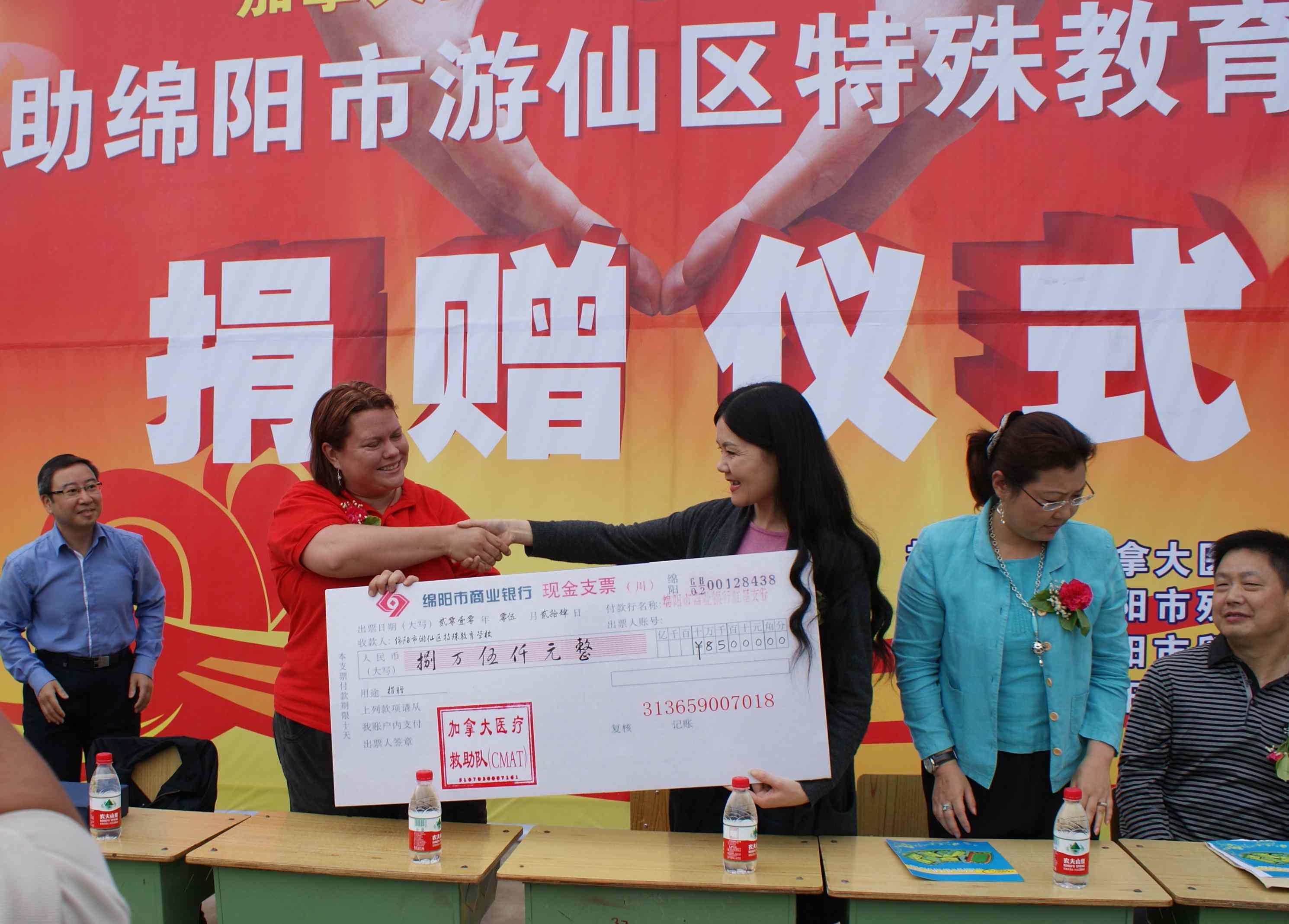
Following the Sichuan earthquake, the Canadian Medical Assistance Teams (CMAT) placed volunteers on standby (May 12–16) and deployed a five-member assessment team to Sichuan from May 17 — an emergency physician, two physicians, and two advanced care paramedics — to verify unmet emergency-health needs, confirm access, and explore a potential Type-1 mobile clinic. Operating in earthquake-affected areas including the Beichuan/Mianyang corridor, the team assisted with medical aid at a local stadium-based temporary centre under local direction (not a CMAT-run clinic) and supplied six cases of pharmaceutical medications to area field hospitals. By May 22, with national surge capacity proving adequate and most of the severely injured already evacuated, officials declined CMAT's clinical team offer, so CMAT redirected donor funds to shelter (tents, cots) and rehabilitation for affected children — including a 2010 contribution of ¥85,000 RMB (~CAD $12,500) to the Mianyang Youxian District Special Education School for rehabilitation equipment. Throughout, CMAT aligned with the government-led, military-supported, Red Cross–backed response, standing down its clinical team to avoid duplication while still making targeted contributions, and the mission validated its ability to mobilize quickly, integrate with host-nation coordination, and pivot from acute care to early recovery.
References
1. Canadian Medical Assistance Teams (CMAT). CMAT Relief effort in China to change focus. 22 May 2008. Available from: CMAT website (cmat.ca).
2. Canadian Medical Assistance Teams (CMAT). CMAT contributes towards Sichuan, China reconstruction efforts. 26 May 2010. Available from: CMAT website (cmat.ca).
3. Canadian Medical Assistance Teams (CMAT). CMAT Executive Director visits memorial for Chinese Earthquake victims. 27 May 2010. Available from: CMAT website (cmat.ca).
4. Canadian Medical Assistance Teams (CMAT). CMAT Assessment Team to depart tomorrow for China. 16 May 2008. Available from: CMAT website (cmat.ca).
5. World Health Organization. Disease outbreak prevention crucial in China earthquake aftermath. News release, 16 May 2008. Available from: World Health Organization website (who.int).
6. United Nations Office for the Coordination of Humanitarian Affairs (OCHA). Sichuan Province, China: Earthquake—Situation Report No. 10. 30 May 2008. Available from: UNOCHA website (unocha.org).
Partners
- Chinese national and provincial health authorities
- Local emergency management and disaster response agencies
- Chinese Red Cross Society
- International Medical Assistance Team (IMAT) partners
- Field hospitals and local medical response teams operating in Sichuan
Key Statistics
| Metric | Result | Source |
|---|---|---|
| CMAT deployment type | Rapid Assessment Team | Type-1 clinical team not authorized by host authorities. ¹ |
| Assessment team size | 5 members | 1 EM physician, 2 physicians, 2 ACPs. ² |
| Assessment period | Mid–late May 2008 | Departed May 17; exact end date not publicly documented. ² |
| Essential medicine support | 6 cases | HPIC Physician Travel Packs to field hospitals. ¹ |
| Shelter/NFI focus | Tents & cots | Per local authority requests. ¹ |
| Recovery-phase grant | ¥85,000 RMB (~$12.5k CAD) | Rehabilitation equipment for special education school. ² |