Haiti Earthquake
~10,000 patient consultations · ~300 surgeries · 26 births · 100 volunteers
Executive Summary
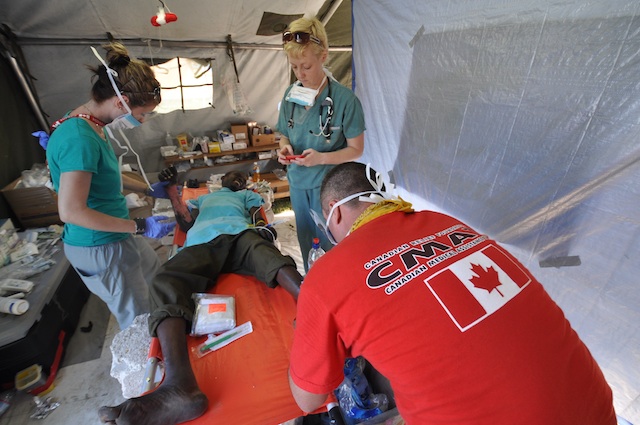
Following the Mw 7.0 earthquake on January 12, 2010, Canadian Medical Assistance Teams (CMAT) deployed an assessment team within 72 hours and rapidly established a field hospital in Léogâne in partnership with the Canadian Forces. Operations provided trauma surgery and emergency/primary care, later transitioning to primary health care and disease surveillance. After March 16, 2010, CMAT transitioned clinical operations to partners in Léogâne and redeployed personnel to staff the health centre at the Pétionville internally displaced persons (IDP) camp in partnership with the Jenkins/Penn Haiti Relief Organization (J/P HRO).
Crisis Context
The earthquake caused catastrophic loss of life and infrastructure: an estimated 220,000 deaths, over 300,000 injuries, and approximately 1.5 million people displaced. Health facilities in and around Port‑au‑Prince and Léogâne were destroyed or severely damaged, necessitating rapid field‑based medical services.¹
Deployment Overview
Following the January 12, 2010 Haiti earthquake, CMAT established a field hospital at École les Frères Louis Borno in Léogâne, adjacent to an IDP camp, operating from January 16 to March 16, 2010 — approximately 60 days — delivering trauma and surgical care alongside daily outpatient services. During this phase, the team completed approximately 14,000 patient consultations and 250 major and minor surgeries, launched a tetanus vaccination initiative, and initiated disease surveillance for vector-borne illness. As trauma caseloads stabilized by late February, clinical focus shifted toward primary health care, wound care, and rehabilitation, with critical and complex cases referred to higher-level facilities including the USNS Comfort and functioning hospitals in Port-au-Prince. Beginning March 19, CMAT transitioned its operations to the Pétionville camp health centre in Port-au-Prince, partnering with J/P HRO to deliver high-volume primary care in an IDP setting, with daily outpatient volumes averaging 200–300 consultations, maternity services on-site, and cumulative deliveries exceeding 120 throughout 2010, staffed by rotating teams of CMAT physicians, nurse practitioners, registered nurses, and paramedics.
References
1. Pan American Health Organization / World Health Organization. Earthquake in Haiti—One Year Later: PAHO/WHO Report on the Health Situation. January 2011.
2. Canadian Medical Assistance Teams (CMAT). Haiti Earthquake: Ongoing Relief Project – Executive Summary / Project Proposal (2010).
3. CMAT. CMAT team Response to the Haiti Earthquake – Roster & team lists (2010).
4. Rzepka VJ, Bennett K, Harms KA, Khan RM, Lombardi RA, LeBlanc J, et al. Response to the 2010 Haïti Earthquake – a Canadian perspective (2010).
5. CMAT. 2010 Earthquake Haiti – Presentation (Feb 2010).
Partners
- UN On‑site Operations Coordination Centre (UN‑OSOCC)
- WHO/PAHO‑led Health Cluster
- Canadian Armed Forces (HMCS Athabaskan; Royal 22e Régiment)
- J/P HRO
Key Statistics
| Metric | Result | Source |
|---|---|---|
| Deployment type | Field hospital (Léogâne) transitioning to primary care; later camp clinic staffing (Pétionville) | Operated with Canadian Forces; later partnership with J/P HRO.²⁻⁴ |
| Length of field hospital operations | ≈60 days (Jan 16 – Mar 16, 2010) | Handover on March 16 to University of Notre Dame Field Hospital.² |
| Primary locations | Léogâne; Pétionville (Port‑au‑Prince) | École les Frères Louis Borno; Pétionville Club IDP camp.⁴ |
| Patient consultations (Léogâne) | ≈14,000 | Aggregate Jan 16 – Mar 16, 2010.² |
| Surgical procedures (Léogâne) | ≈250 major & minor | Orthopaedic and other procedures; 10–12/day early weeks.²,⁴ |
| Daily outpatient volume (Pétionville clinic) | ≈200–300/day | Joint clinic staffed with J/P HRO.⁴ |
| Deliveries | ≥10 (Léogâne); ≥120 (Pétionville clinic, 2010) | Léogâne: births during CMAT operations; Pétionville: clinic total with partners.⁴ |
| Vaccination & surveillance | Tetanus vaccination; communicable‑disease surveillance; vector‑borne monitoring | Initiated during CMAT operations.²,⁴ |
| Referrals | Transfers to USNS COMFORT and functioning hospitals | For complex/critical cases beyond field capability.⁴ |
| CMAT personnel | 50+ rotating volunteers across 6+ teams | MDs (emergency, primary care, orthopaedics, anaesthesia), NPs, RNs, ACP/PCP paramedics, logistics/SAR.³,⁴ |