Kashmir Earthquake
~300–400 outpatient consults per day
Executive Summary
Following the Mw 7.6 earthquake that struck Azad Jammu & Kashmir on October 8, 2005 — killing an estimated 73,000–86,000 people and displacing over 3.3 million — CMAT deployed at least five medical teams by December 3, with four further rotations scheduled through mid-February 2006, delivering facility-based wound care at Abbas Institute in Muzaffarabad, post-operative and rehabilitation surge support at PIMS in Islamabad, and helicopter-supported mobile outreach to remote, unreached villages. Upon the redeployment of Canadian Forces DART, CMAT was asked to assume staffing of the Garhi Dupatta clinic in partnership with the Pakistan Red Crescent, sustaining approximately 300–400 outpatient consultations per day, while also training and certifying eight local health workers in wound care to strengthen continuity of services. In parallel, CMAT coordinated the distribution of 1,000 winterized tents and 5,000 thermal quilts and blankets to an estimated 3,000 families — approximately 18,000 people — supported by approximately CAD 190,000 in CIDA matching funds and additional grants from Mercy-USA totalling roughly CAD 300,000 for winterization and USD 22,000 for an inflatable field facility.
Crisis Context
On 8 Oct 2005, a Mw 7.6 earthquake struck Azad Jammu & Kashmir and NWFP/Khyber Pakhtunkhwa, causing mass casualties, large-scale displacement, and severe damage to health infrastructure. In Muzaffarabad, the Combined Military Hospital was reported out of service; Abbas Institute became the principal functioning hospital in the immediate aftermath. Priority needs included trauma after-care and infection control, primary health care in remote valleys, and rapid winterization to prevent excess morbidity and mortality.
Deployment Overview
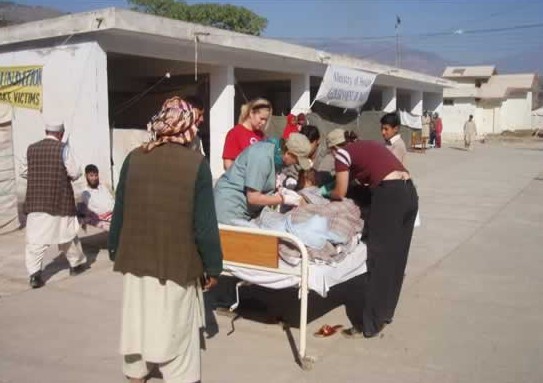
Following the October 2005 Kashmir earthquake, CMAT delivered a multi-modal response across affected areas of Pakistan, opening a wound-care clinic in Muzaffarabad to manage complex wound infections and perform minor amputations when indicated, while also training and certifying eight local staff in wound care to strengthen continuity of quality services. Helicopter-supported mobile teams reached remote settlements to provide primary care, wound management, and triage for air evacuation to referral facilities, while CMAT simultaneously augmented capacity at PIMS for post-operative and rehabilitation care. At Garhi Dupatta, CMAT ensured continuity of outpatient services sustaining approximately 300–400 OPD consultations per day following handover, in partnership with the Pakistan Red Crescent Society. In parallel, CMAT coordinated the procurement and distribution of 1,000 winterized tents and 5,000 quilts and blankets, prioritizing the most vulnerable households and reaching an estimated 3,000 families — approximately 18,000 people — ahead of winter. Throughout the response, CMAT integrated with the WHO Health Cluster, PRCS, IOM, the Shelter Cluster, and Canadian Forces DART, supported by targeted grants from CIDA and Mercy-USA.
Partners
- International Organization for Migration
- Pakistan Red Crescent Society
- World Health Organization
- Canadian Forces DART
- Canadian International Development Agency
- Mercy-USA for Aid and Development
- Pakistani health authorities and local healthcare institutions
Donors
- Targeted grants (CIDA matching; Mercy-USA)
Key Statistics
| Metric | Result | |
|---|---|---|
| Teams Deployed | At least 5 medical teams (≈6–8 personnel each) deployed by 3 Dec 2005, with 4 further rotations scheduled through mid-February 2006. | |
| Clinical Services (Facility-Based) | Wound-care clinic established at Abbas Institute of Medical Sciences (Muzaffarabad); minor amputations performed; post-op/rehab surge support at PIMS (Islamabad). | |
| Local Capacity Built | 8 local health workers (5 staff + 3 nurses) trained and certified in wound care at Abbas Hospital. | |
| Continuity of Care After Handover | Following Canadian Forces DART redeployment, CMAT was asked to staff the Garhi Dupatta clinic (handed to Pakistan Red Crescent), sustaining ~300–400 outpatient consults/day. | |
| Remote Access (Health Cluster Tasking) | Helicopter-supported mobile teams deployed to unreached villages for primary care and triage/evacuation. | |
| Winterization Support (NFIs) | 1,000 winterized tents and 5,000 thermal quilts/blankets distributed, reaching ~3,000 families (≈18,000 people). | |
| Funding Leveraged | CAD ~190,000 (CIDA matching) to support team deployments; additional grants from Mercy-USA (incl. ~CAD 300,000 / USD 250,000 for winterization and USD 22,000 for an inflatable field facility). | |
| Context (UN/Partners) | Earthquake Mw 7.6; ~73,000–86,000 deaths; ≥3.3 million displaced. Abbas Institute functioned as Muzaffarabad's primary surgical hospital early on; DART treated >11,700 patients and produced >3.8 million liters of safe water prior to handover. |